New vs Used Gaming PC: the $1,000 Comparison

Hey there, fellow tech traveler! Grab a drink, pull up a mismatched ergonomic chair, and let’s chat. You know that feeling when you have exactly $1,000 burning a hole in your pocket? It’s a dangerous amount of money. It’s enough to make you feel like a king at a big-box retailer, but if you aren’t careful, it’s also just enough to get you "scammed" by shiny packaging and clever marketing (read this if you want to find out more!).
As your resident "next door geek friend," I’ve spent more time looking at benchmarks than I have looking at actual sunlight. I’ve seen the industry shift from "value-oriented" to "margin-obsessed." Today, I want to show you a side-by-side reality check that might just save your gaming life (and your bank account). We're going to dismantle the lies the hardware giants tell us and look at why that $1,000 in your hand has way more power than the retail stores want you to believe.
The $1,000 Showdown: A Tale of Two Towers
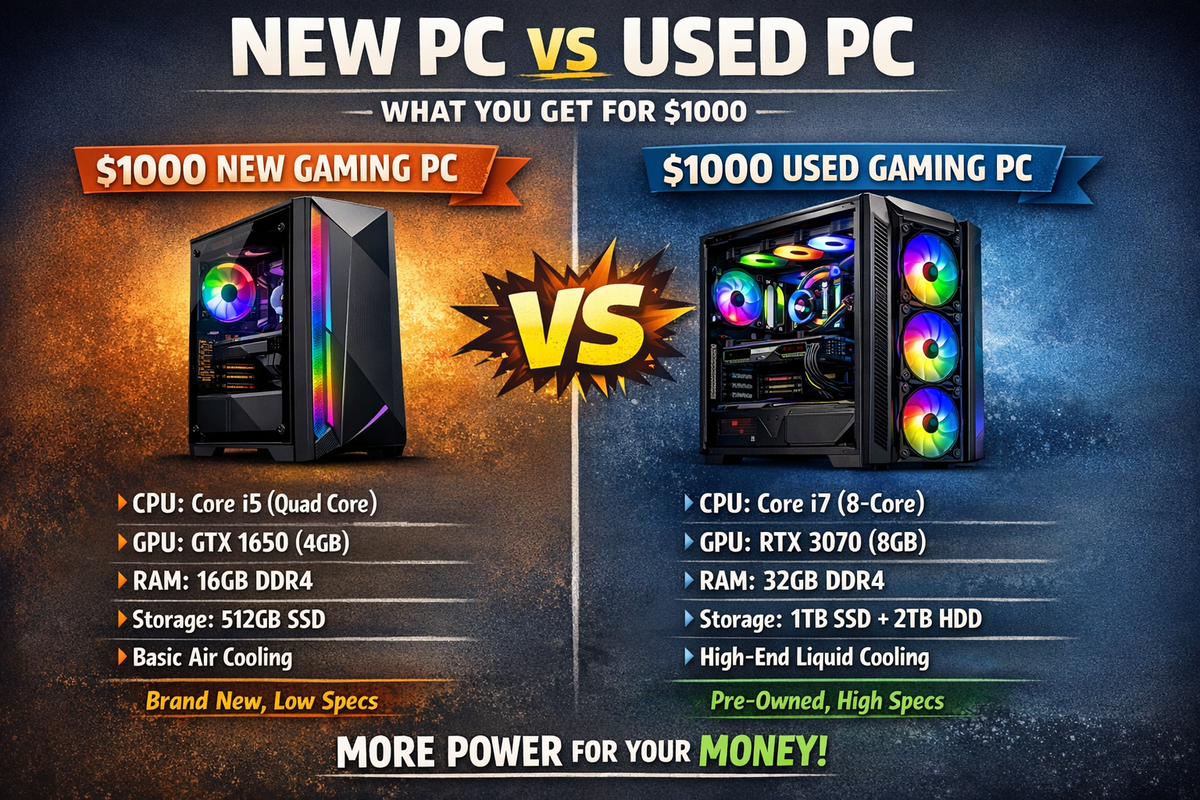
Before we dive into the lies, let’s look at the "Value Gap." I recently saw a comparison that perfectly illustrates the trap many first-time builders fall into. On one hand, you have the "Brand New" experience, and on the other, the "Savvy Second-Hand" beast.
The New vs. Used Comparison (At the $1,000 Mark)
| Feature | The $1,000 "New" PC (The Retail Trap) | The $1,000 "Used" PC (The Enthusiast Move) |
| CPU | Core i5 (Quad-Core) | Core i7 (8-Core) |
| GPU | GTX 1650 (4GB VRAM) | RTX 3070 (8GB VRAM) |
| RAM | 16GB DDR4 | 32GB DDR4 |
| Storage | 512GB SSD | 1TB SSD + 2TB HDD |
| Cooling | Basic Air Cooling | High-End Liquid Cooling |
| Performance | 1080p / Medium Settings | 1440p / Ultra / Ray Tracing |
Looking at this, it’s almost painful, isn't it? The "New" PC gives you entry-level specs that will struggle with modern AAA titles in 2026. Meanwhile, for the same thousand bucks, the used market yields a machine that can actually handle high-refresh-rate gaming and heavy multitasking.
Now, let’s talk about the lies they tell you to make that weaker, "new" PC look like a good deal.
Lie #1: "New Entry-Level Hardware is Optimized for Modern Games"
This is perhaps the most frequent lie found on the stickers at your local electronics store. They’ll tell you that because a RTX 3050 is "modern architecture," it’s better than a flagship card from a few years ago.
The Hardware Bottleneck
In reality, a "new" budget card is often a cut-down version of older tech rebranded to fill a price bracket. As TechPowerUp’s GPU Database shows, the raw compute power (TFLOPS) and memory bandwidth of an older high-end card like the RTX 3070 or RTX 2080 Ti absolutely dwarfs modern entry-level "new" cards.
When a game like Cyberpunk 2077 or Starfield asks for resources, it doesn't care if your card is "brand new." It cares about how many pixels it can push and how much VRAM it has to store textures. A 4GB card in 2026 is, quite frankly, a paperweight for serious gaming.
Lie #2: "The Warranty is Your Only Safety Net"
Manufacturers love to sell you on the "peace of mind" that comes with a 1-year limited warranty. They want you to believe that used hardware is a ticking time bomb that will explode the moment you hit the power button.
The Reliability Truth
Modern PC components—especially CPUs and RAM—are incredibly durable. According to long-term reliability studies often discussed by Gamers Nexus, if a CPU survives its first 48 hours of operation, it is likely to last for a decade or more.
Furthermore, many high-end used parts (like power supplies from Seasonic or Corsair, or RAM from G.Skill) often come with 10-year or lifetime warranties that are tied to the serial number, not the original purchaser. By buying used, you aren't just getting better specs; you're often getting components that were built with higher-quality capacitors and VRMs than the "budget" parts found in a $1,000 new pre-built.
Lie #3: "You Don't Need More Than 4-6 Cores for Gaming"
In the "New PC" column of our comparison, we see a Quad-Core i5. The marketing lie here is that "Games mostly use a single core anyway."
The Multitasking Reality
While it’s true that single-core speed matters, modern gaming in 2026 doesn't happen in a vacuum. You probably have Chrome open with 20 tabs, Discord running a video stream, Spotify playing in the background, and maybe an AI-upscaling tool working in the tray.
An 8-core Core i7 (found in our used build) provides the "headroom" that prevents stuttering and frame-time spikes. As games become more CPU-intensive with complex physics and AI, those extra cores aren't just a luxury—they are the difference between a smooth 60 FPS and a choppy, frustrating mess. Check out Eurogamer's Digital Foundry for deep dives into how modern game engines are finally utilizing high core counts.
Lie #4: "Buying New is the Only Way to Get a 'Balanced' Build"
Retailers love to claim their systems are "professionally balanced for performance." They’ll pair a modern-ish CPU with a bottom-tier GPU and tell you it’s a "harmonious system."
The Imbalance Trap
Look at our $1,000 comparison again. The "New" PC pairs a Core i5 with a GTX 1650. That is a massive mismatch. The CPU is sitting idle while the GPU is gasping for air.
Conversely, a $1,000 used build is often a former flagship. It was built by someone who cared about the "Golden Ratio" of PC building. You get an 8-core i7 that can handle streaming, video editing, and background apps, paired with a GPU that can actually utilize that speed. Buying used allows you to step into a tier of "Enthusiast Balance" that simply doesn't exist at the $1,000 retail level.
Lie #5: "Storage Speed is All That Matters (Ignore the Capacity)"
The "New PC" gives you a 512GB SSD. In 2026, with game installs regularly exceeding 150GB (Call of Duty, anyone?), that drive is full after three games. The lie is that "Fast NVMe speeds make up for small sizes."
The Capacity Crisis
Speed is great, but you can’t run a game that isn't installed. The used build provides a 1TB SSD plus a 2TB HDD. This allows for a "tiered" storage strategy:
- SSD: For your OS and your top 3 most-played games.
- HDD: For your massive library of indie games, media files, and backups.
Buying used allows you to escape the "storage tax" that manufacturers use to up-sell you to the next tier of pre-built machines.
Why "Used" May Be Better: The Practical Breakdown
Beyond the specs, there is a strategic advantage to the second-hand market that goes beyond the hardware itself.
1. The "Depreciation Curve" is Your Friend
New PC hardware loses about 30% of its value the moment the box is opened. By buying used, you are letting someone else pay that "newness tax." This is why, as seen in our table, you can jump from a low-end GTX 1650 to a high-end RTX 3070 without spending an extra dime.
2. Better Peripheral Ecosystem
Often, when people sell their "used" gaming rigs, they are looking to get out of the hobby or upgrade entirely. This means you can often find "bundle" deals that include a mechanical keyboard, a high-refresh-rate monitor, or a decent mouse for a fraction of their retail price. Using sites like PCPartPicker to track historical pricing can help you spot when a used bundle is an absolute steal.
3. The "Enthusiast" Build Quality
Most $1,000 new PCs are "mass-produced" with the cheapest possible motherboards and power supplies (the "hidden" components). A $1,000 used PC was often someone's "baby"—built with a high-quality motherboard that has better audio shielding, more USB ports, and better Wi-Fi.
How to Navigate the Used Market Without Getting Burned
I wouldn't be your "next door geek friend" if I didn't warn you about the pitfalls. If you decide to go the used route, follow these rules:
1. The "Stress Test" is Mandatory
If you’re buying in person, ask the seller to run OCCT or Heaven Benchmark for 10 minutes. If the PC doesn't crash and the fans don't sound like a jet engine taking off, the "bones" of the system are likely solid.
2. Inspect the "Dust Habit"
A clean PC is a loved PC. If you open the side panel and see layers of gray cake on the fans, it’s a sign the previous owner didn't care about maintenance. It’s not a deal-breaker, but it’s a great way to negotiate the price down by $50 for "cleaning services."
3. Check the Power Supply (PSU)
Always ask for the specific model of the PSU. If it’s a generic "grey box" with no 80+ rating, factor in $70 to replace it with something reliable. A bad PSU is the only part that can actually "kill" the rest of your hardware.
Conclusion: Use Your Brain, Not Just Your Wallet
At the end of the day, the hardware industry is a machine designed to make you feel "behind." They want you to think that if you aren't buying the newest i5 with the newest budget GPU, you aren't a "real" gamer.
But look back at that comparison table. For the same $1,000, you can either have a "new" PC that struggles to keep up, or a "pre-loved" beast that dominates 1440p gaming and looks incredible doing it. The choice isn't just about money; it's about respect—respect for your hard-earned cash and respect for the hobby.
Don't let the glossy marketing and the "new car smell" of a retail box blind you to the raw performance waiting for you in the second-hand market. You’re a geek now; you’re one of us. And we don’t overpay for "entry-level" when we can own "enthusiast-grade" for the same price.
What’s your budget looking like? If you’ve found a used listing and you’re not sure if the parts are compatible or if the price is fair, hit me up!